Purpose-built
intelligence.
Built around
your team.
Your investment expertise. Your own technology team. We turn the work you know into focused applications that remove friction—and give you time back.
FLATS
240 apartment homes
198,000 rentable sq. ft.
Explore the tabs. These examples illustrate intended workflows, not live document processing.
Our product direction
Source documents, reviewed once and cited to the page.
You bring the problem.
We deliver the tool.
ASIC means an Application-Specific Integrated Circuit—a chip built for one job. That analogy shapes our work: purpose-built software, not generic hardware or mining services. CTO means Chief Technology Officer-style leadership aligned to business outcomes. ASI in the name references artificial superintelligence as brand ambition only; it is not a claim that superintelligence exists here.
We scope, build, and refine the application around the work your team actually needs to do.
Your IT team keeps the business running. ASICTO adds focused AI and application expertise to help it move forward.
Built around your team.
The forms, screens, and actions your people need. Every feature has a job; every screen has a clear next step.
A bounded engagement.
One workflow, a working increment, and a named owner after handoff—not an open-ended program to manage alone.
Your technology partner, through the handoff.
Architecture, data, development, and ongoing improvement—with ownership and support agreed from the start.
Drop in the deal.
Get back to the investment.
Information should move with the investment. From the first document to the next form, model, report, and decision.
Deal intake, accelerated.
Extract property facts and stated assumptions from an offering memorandum. Prepare the record and flag missing or conflicting information for review.
View demo →Forms, already started.
Populate recurring forms, checklists, and approval materials from reviewed information. Keep the investment judgment; remove repeated entry.
View demo →Financials, brought to life.
Structure income statements, map line items, and investigate trends and variances. Trace a figure back to its source.
View demo →Your income statement has a story to tell.
Spend less time reformatting columns. Spend more time understanding the movement, testing assumptions, and deciding what to ask next.
Every number should trace to a reviewed source.| LINE ITEM | PRIOR T12 | CURRENT T12 | CHANGE |
|---|---|---|---|
| Effective gross income | $5,400,000 | $5,700,000 | +5.6% |
| Operating expenses | $2,100,000 | $2,300,000 | +9.5% |
| Net operating income | $3,300,000 | $3,400,000 | +3.0% |
Expenses are growing faster than income at the total level.
Line-item detail is not shown in this sample. Synthetic figures only; mappings would require reviewer confirmation in a real engagement.
The context stays.
Even after closing.
These are Rudbek Living’s own screens in demo mode — sample data only, as published on demo.tenureos.io — with its deep-navy chrome, gold-and-teal charts and governed, source-labelled tables. Tour them with Rudbek’s own navigation, then open any screen in the demo.
Apartment portfolio performance
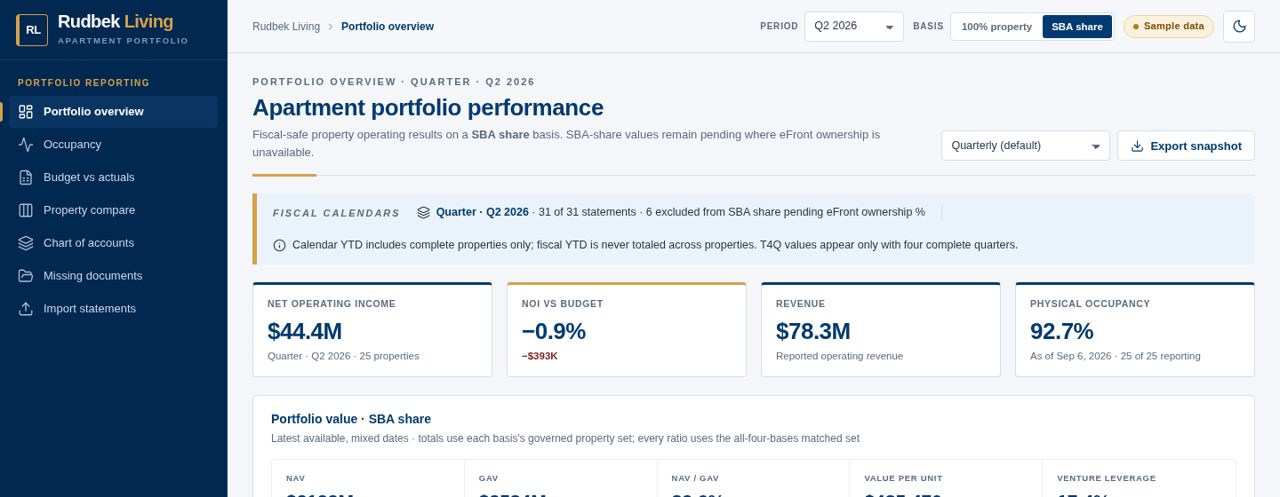
Click a bar, open the property
The NOI-by-property chart is a door, not a picture — every bar opens that property’s detail.
Explained, or it stays cautioned
NOI differences are labelled explained only when a stated convention explains them.
Complete properties only
Calendar YTD counts complete statements only, and says how many — 11 of 11 here.
Budget vs FYTD actuals
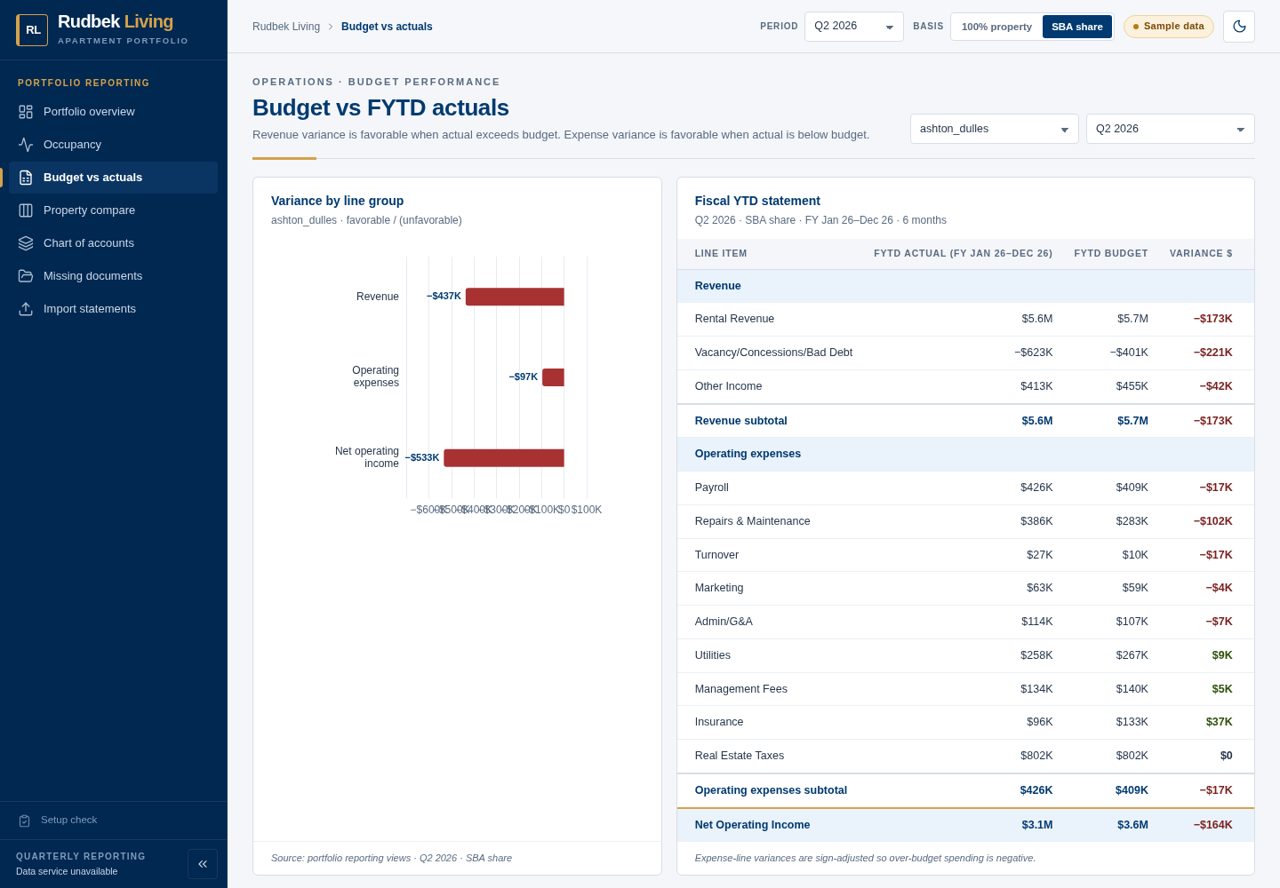
Each property’s own fiscal year
Statements run on the property’s fiscal year-end and months elapsed — never a forced calendar.
Overruns read negative
Expense variances are sign-adjusted, so favourable and unfavourable never swap meaning.
Group first, lines on drill
Start at the line group, then open the statement lines behind it.
Line-item ranking
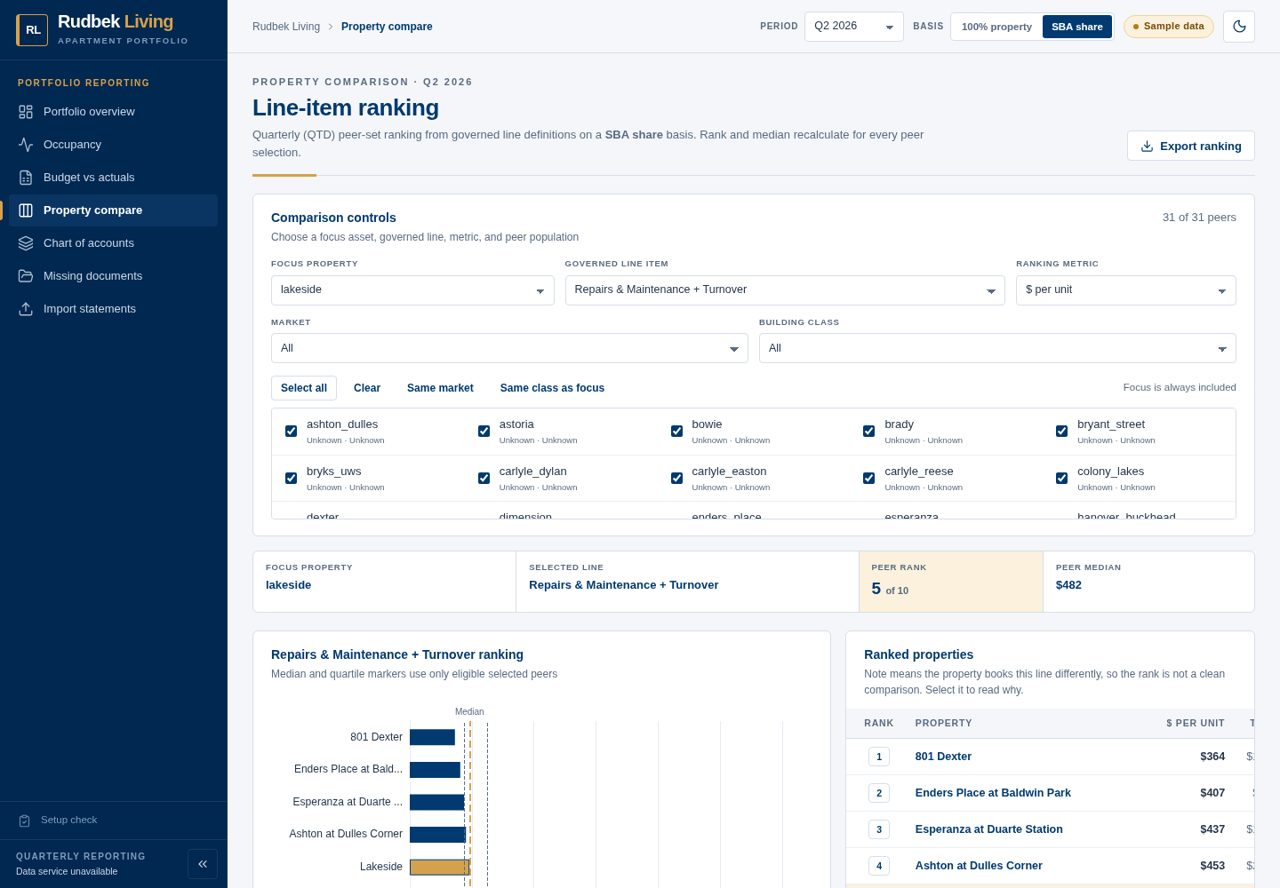
Any governed line, ranked
Repairs, payroll, utilities — ranked across the portfolio in dollars per unit.
Medians you can trust
Quartiles use eligible peers only; excluded properties never move the median.
“Note” before you judge
A note chip means the property books the line differently — read why before trusting its rank.
Property detail
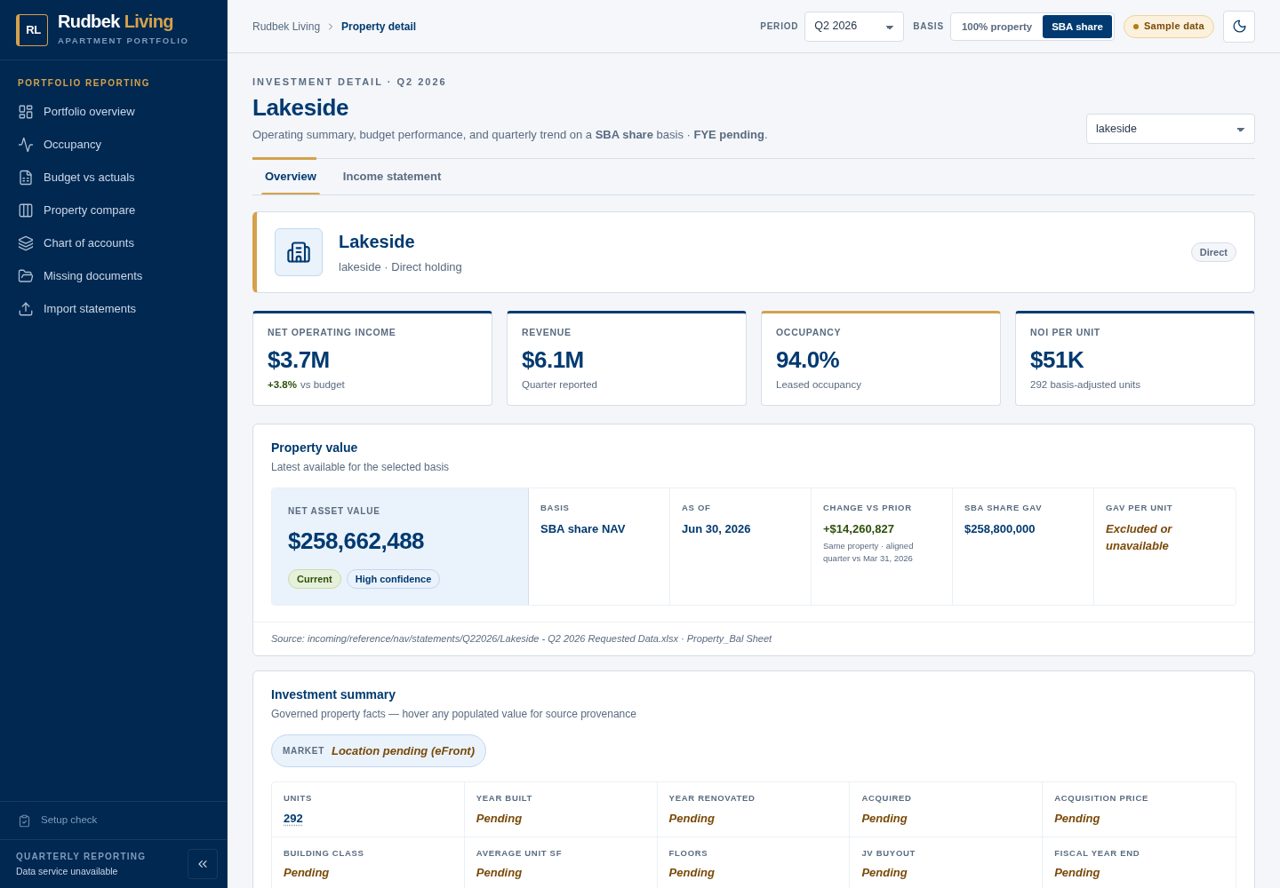
One property, whole story
Quarterly revenue, NOI and budget trend with the investment snapshot beside it.
Occupancy in context
The trailing-13-week occupancy mini sits on the same page as the financials.
Straight to the statement
Fiscal YTD highlights link directly into the full income statement.
Income statement
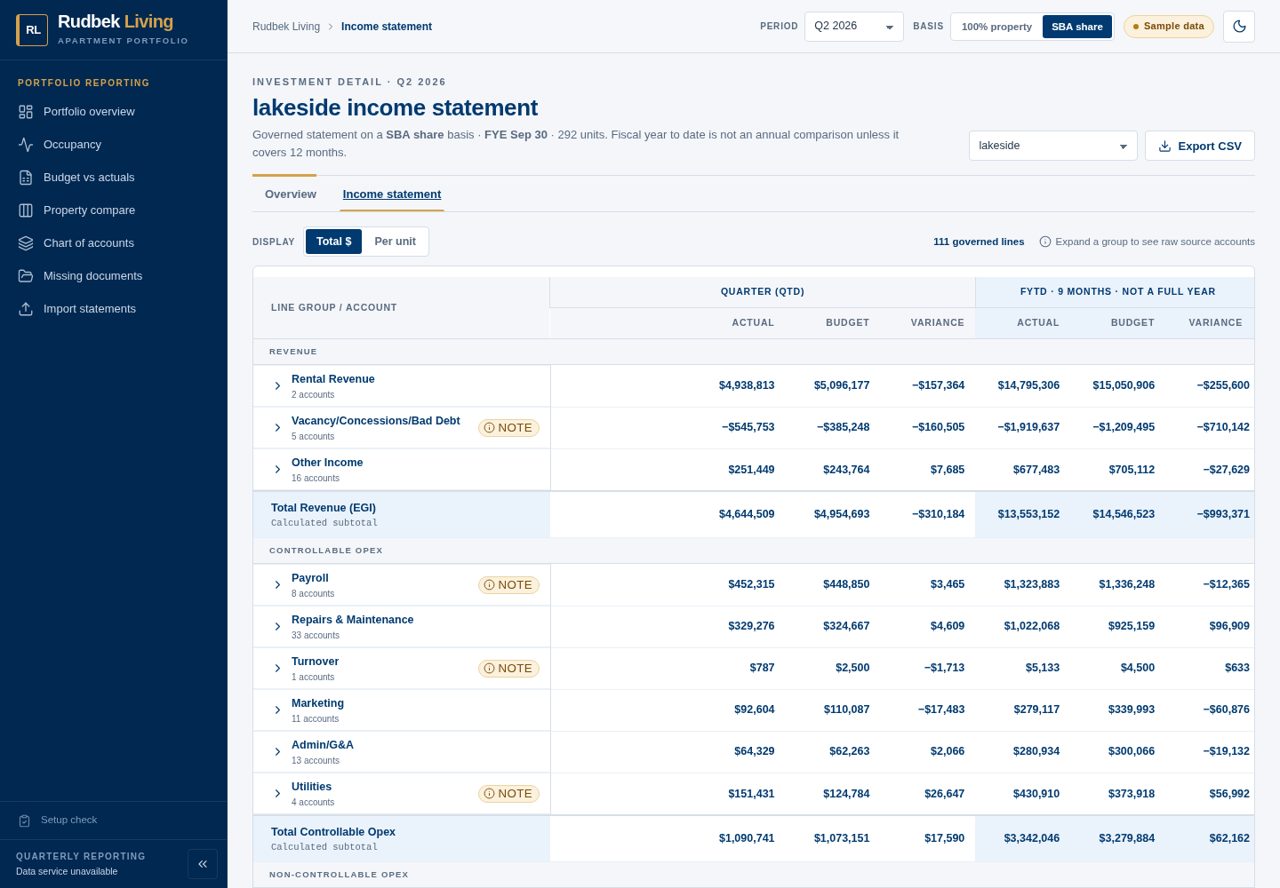
Governed lines, local names kept
Standard lines carry the property’s own local account labels as secondary text.
NOI reconciliation, visible
Reported NOI shows its tie status against mapped lines — explained or cautioned, in place.
Drill to the accounts
Expand a group to the local accounts that actually booked the numbers.
Missing documents
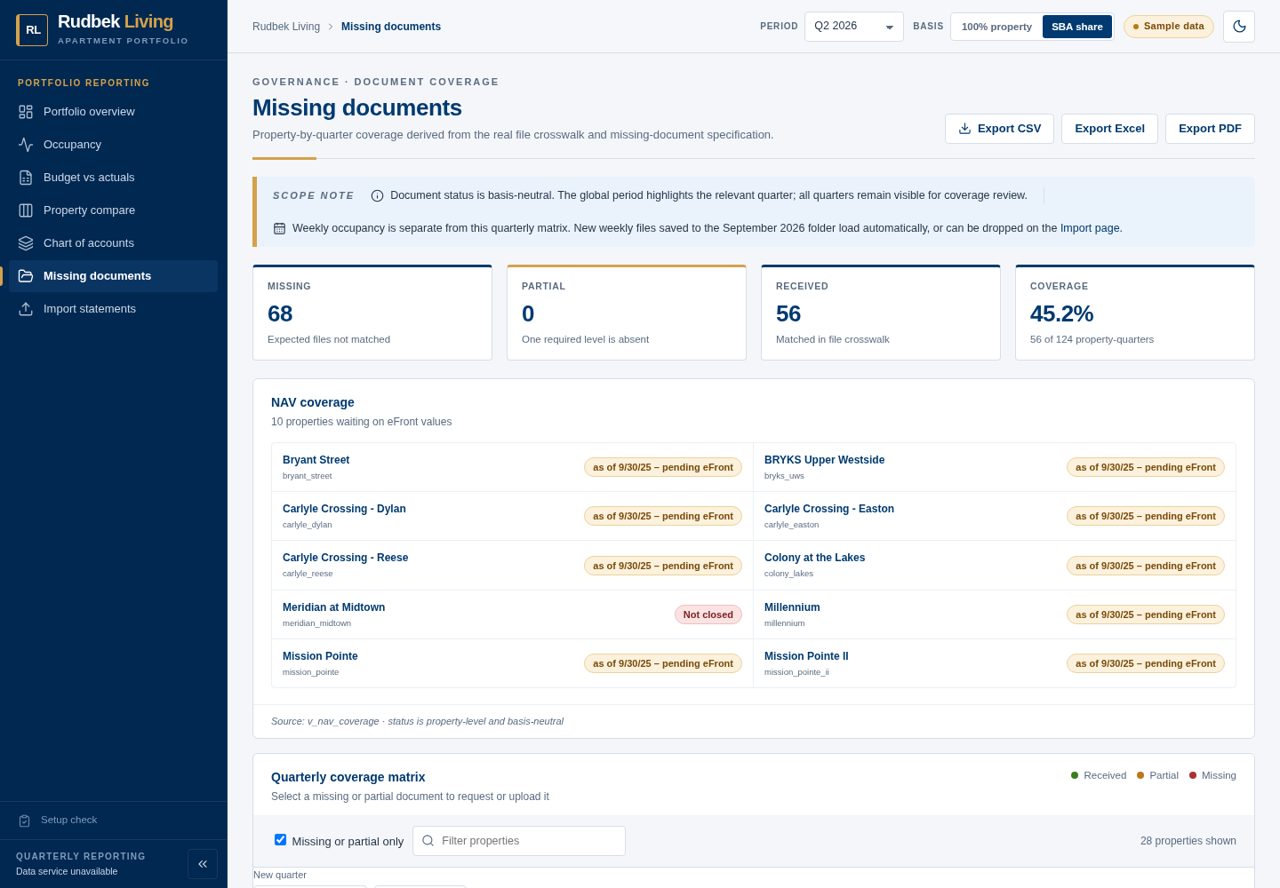
Missing reads red
The quarterly matrix makes an expected-but-absent file obvious at a glance.
NAV gaps named
Properties still waiting on eFront values are listed, not averaged away.
Close the gap in place
Select a missing or partial cell to request or upload the document; export as CSV.
Import reports
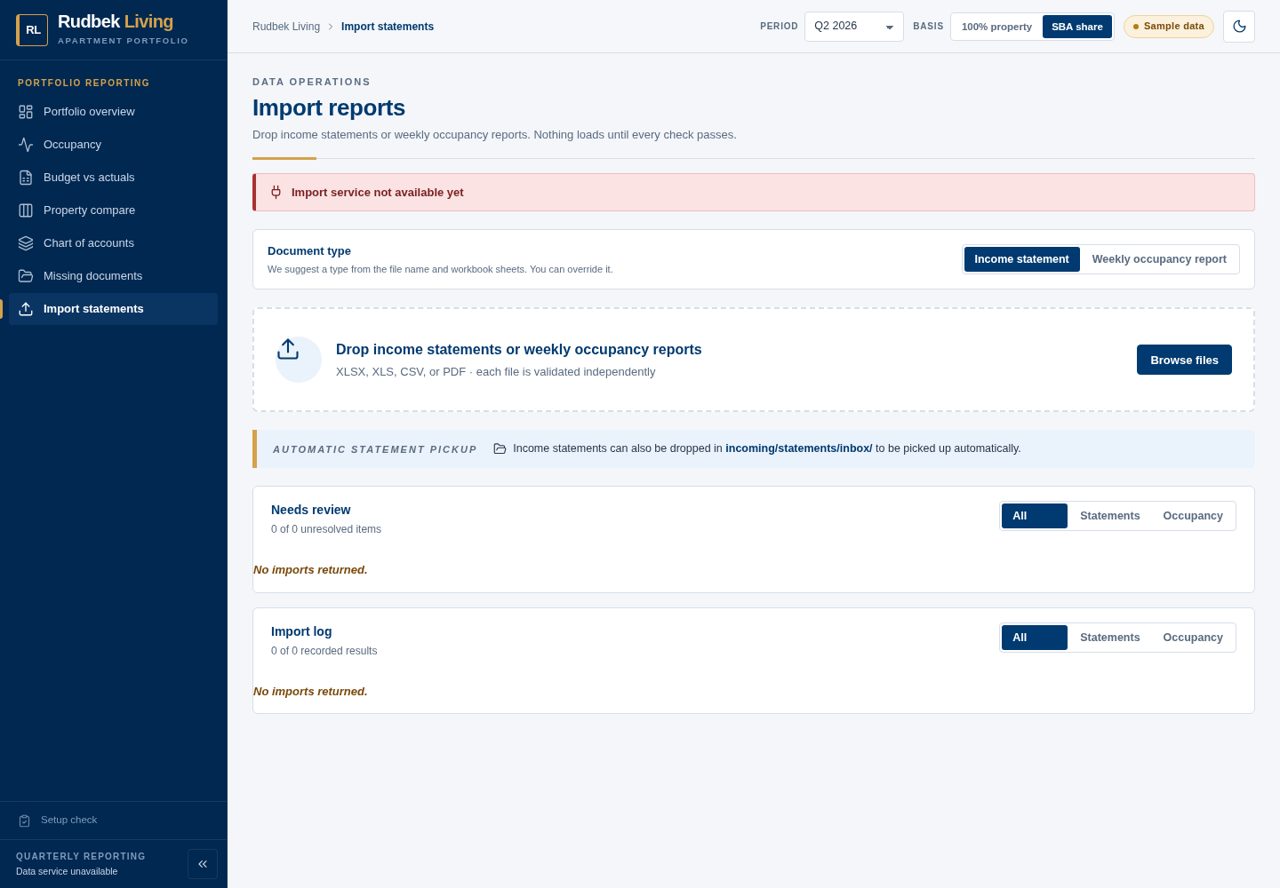
A gate, not a folder
Files are recognised, matched and checked — nothing loads until every check passes.
Review queue with reasons
Anything uncertain waits in Needs review, in plain language, never silently dropped.
Every file accounted for
The import log keeps each recorded result, so “what happened to that file?” has an answer.
Your data.
Your next chapter.
A client-controlled database is the intended system of record, with focused applications above it. This site does not ship a schema, connector, or migration toolkit—those are design-partner scopes.
Existing records
Authorized exports, spreadsheets, documents, and agreed source-system access.
Map & reconcile
Historical checks, visible exceptions, and client review before cutover.
Your database
PostgreSQL is an initial candidate to evaluate; other enterprise databases depend on requirements.
Your applications
Investment workflows, analysis, forms, and reporting built around your team.
Migration (design partner): eFront and Dealpath work is scoped per client. Export format, field coverage, and any API access are not verified on this site.
Built to extend: source-code access, self-hosting, and open-source release options can be scoped where appropriate. Delivery and licensing terms are agreed per engagement.
From “we need”
to “we use.”
Practical technology leadership, focused development, and a clear handoff. We help you choose what to build and get it into the team’s everyday work.
Find the friction.
Map the workflow with the people doing the work. Establish the baseline, constraints, and a specific outcome worth delivering.
Build the useful thing.
Use AI-assisted development and reusable foundations to build a focused application. Review working increments against agreed examples.
Make it everyday.
Train users, document ownership, and measure the result. Agree ongoing support and refine the workflow as your business changes.
Built around the work,
from asset to allocator.
These disciplines inform the product design. They are not a published team, client list, or track record.
Does the investment case hold?
Acquisitions, DCF modeling, budgets, and investment analysis inform how information should move from initial screen to committee.
Do the numbers reconcile?
An accounting-led perspective on asset management, portfolio oversight, and separate-account reporting informs the data foundation.
Can the story be supported?
Institutional allocator, fundraising, and investor-relations perspectives inform how approved information becomes a credible investor narrative.
Clear expectations.
Useful answers.
Are you replacing our IT department?
We add investment-workflow, AI, and application-development expertise. Infrastructure, security, identity, and access remain important shared considerations. We work with your technology owners to agree how the application will operate and who will support it.
Will we have to build our own dashboards?
Our service is to deliver the agreed application and workflow, including the views and reports your team needs. Your team can extend the work if you choose; it is not a prerequisite for getting value.
Can our developers take it forward?
Yes, extensibility can be designed into the engagement. Source access, documentation, self-hosting, and licensing are scoped explicitly. Public open source is a separate option from giving a client access to its delivered code.
Is everything shown here available today?
This site presents our service approach and product direction. Rudbek is an existing prototype using sample data. OM extraction, automated forms, financial-analysis workflows, and migration tooling shown here are concepts to scope and validate with design partners, not claims of production deployment.
How do you measure efficiency?
Agree a baseline before building: time to a reviewed deal record, repeated data-entry steps, reconciliation effort, reporting preparation, or another workflow-specific measure. Validate the result using the same task and comparable inputs.
Tell us where
the work gets stuck.
Start with one workflow. See what we could move forward.